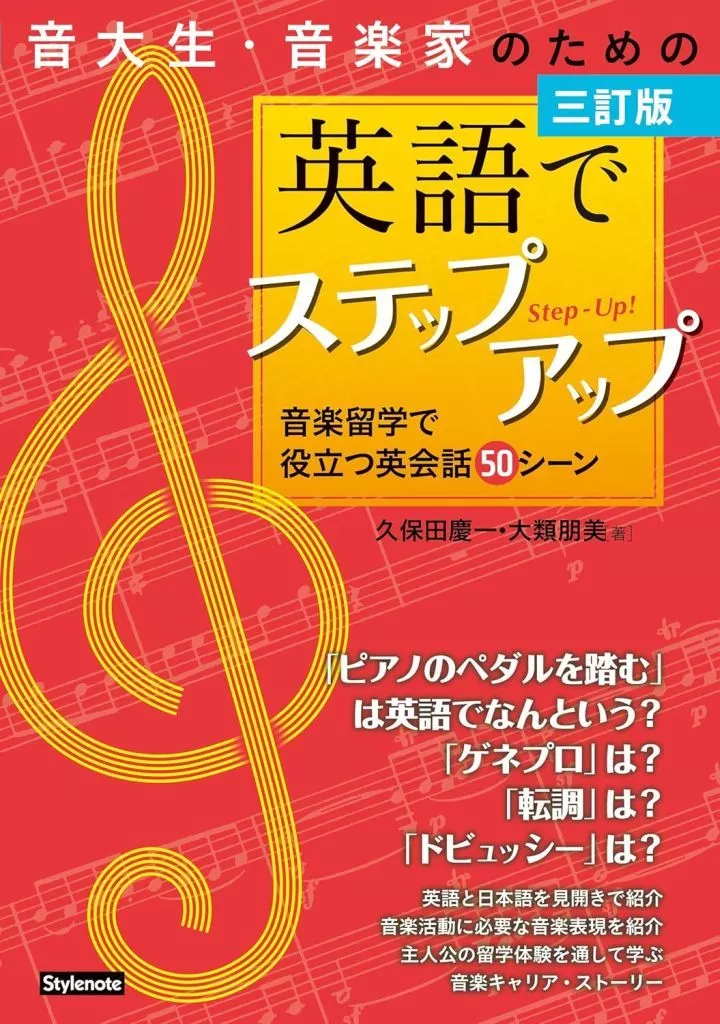
Step-up in Santei Fune Ou, English for Musicians / Keiichi Kubota / Tomomi Orui


Product description ※Please note that product information is not in full comprehensive meaning because of the machine translation.
English
[Contents introduction]
This book teaches music's unique English expressions and English conversation.
Learn from 50 English conversation stories about taking music lessons, planning and holding concerts and participating in society through music.
The scene where the main character who studied music in the United States met in the actual study abroad scene is reproduced, such as taking lessons, proceeding with ensemble practice, planning concerts, and participating in the community with music.
It explains in detail how to express it in English.
In addition to the explanation according to the theme for each scene, at the end of the book, there is also an English music-related glossary and an illustrated English vocabulary.
It is not just a reference book for English conversation, but the story is developed while thinking about the music career development such as the relationship between the musicians who are spreading globally and society, and how to act in the international society as a musician.
This book is useful not only for music Ou and music high school students, but also for those who are active in music and music lovers.
The highly acclaimed English version published in 2017 has been revised to reflect more modern and realistic conversations.
Contents
Introduction
Outline
■ Chapter 1 The f irst lesson
■ Chapter 1 First Lesson
1 How long have you studded music in Japan?
2 I like Glenn Gould's performance
I like Glenn Gould's performance.
3 do I need to remember the piece?
4 did you play the piece as though you were singing it?
5 what about the pedal?
● Column 1 on the language "English"
■ Chapter 2 Accompanying the f little
■ Chapter 2 Accompany the flute
1 Can you be my accompanist?
2 Will You Play just as you would at the concert?
Will you play as if you were in the concert?
3 if you listen to each other too much, it won't work
It won't work if you listen to each other.
4 Would you mind speaking to the audience before performing?
5 Thank you for inviting us to perform today
Thank you very much for letting me perform at the concert today.
● Music Terminology in Column 2 "English"
■ Chapter 3 At the party
■ Chapter 3 At the party
1 Thank you for listening to us play today
Thank you for listening to our performance today.
2 This will be a good experience for me
I think you'll have a good experience.
3 it is very diff icult when the tempo changes
It's very difficult when the tempo changes.
4 Don't young Japanese students go see Kabuki?
5 We Will Play Akatombo, which means red dragonfly in Japanese
We will play the Japanese song "Akatonbo."
● Column 3 Relationship between I've Sound and and Music
■ Chapter 4 Accompanying the cello
■ Chapter 4 Accompanying the cello
1 never improvised!
2 My improvisation will probably sound more like Chopin
Improvisation will become like chopin.
3 I get nervous very easily
I'm a climber.
4 I was too busy just following the complicated piano part
The music was so difficult that I could only do my best to watch the piano part.
5 I am worried about the improvisation
I'm worried about improvisation.
● Column 4 : "Improvisation" Required today
■ Chapter 5 a concert at an elementary school
■ Chapter 5 Elementary School Concert
1 I fell in love with music as my mother sang songs to me when I was little
I came to like music because my mother sang songs when I was little.
2 Does anyone have anything to say about the performance?
3 This town is home to wonderful teachers and students, not only from Japan, but from all over the world.
This town is home to wonderful teachers and students, not only from Japan but also from the world.
4 How did you become so fluent in English?
5 I realized that there is a lot I need to work on
I have a lot to reflect on.
● Column 5, "New Audience" and "Teaching Artist" work
■ Chapter 6 Some questions at the piano lesson
■ Chapter 6 Questions in Piano Lesson
1 I wasn't conf ident in my performance
I'm not sure if I could play well.
2 it is very important to feel the whole performance as one big line
The important thing is to feel the whole performance as a big line.
3 it is not enough to merely play the notes written on the music
Simply making the notes in a score sound is not enough.
4 we want to perform for those who are unable to attend a concert at the concert hall.
We want people who can't go to the concert hall to listen to the performance.
5 Simply put, to have a common mission
In short, it's about sharing a mission.
● Column 6 Connection between Music and Society
■ Chapter 7 Forming the Asian Trio
1 Whatever the pieces we select, I want to reach out to the
community
I want to deliver any music to society.
2 Before listening to the music, we are participating them in its construction
You want to experience how the music works before listening.
3 Let's start up our website
Let's start with creating a site.
4 Did you bring an Asian outfit to bring out the Asian image?
5 We got an offer to perform
I got an offer to perform.
● Column 7, "Portfolio Career"
■ Chapter 8 The first concert
■ Chapter 8 First Concert
1 We should plan music that both the children and their parents can enjoy
You have to think about songs that parents and children can enjoy.
2 I want to play not only an accompanion, but also a solo
I want to play solo as well as accompaniment.
3 Do you think the kids can identify where the songs are from?
Do you think the kids can identify where the songs are from?
4 I arranged this piece especially for you
I arranged this song specially for you.
5 we'd better think about our trio's future.
We have to think about the future of our trio.
● Column 8 About Music and Career Career
■ Chapter 9 The last lesson
■ Chapter 9 Last Lesson
1 It's crucial to have a good communication skills
I think it is to communicate with each other.
2 Please try to stay awake until the end, if you can
If you can, listen to it until the end without sleeping.
3 It was hard for me to express what I wanted
I couldn't express myself.
4 I learned to express myself and to play with my own voice and emotions
You can now express yourself and play in your own way.
5 a musical's work has changed quite a bit since I was a student.
The content of musician's work has changed a lot since I was a student.
● Column 9 About Globalization and the Internet
■ Chapter 10 Go forth, the Asian Trio!
■ Chapter 10 is Batake, Asian Trio
1 I think we should continue to work as a trio wherever the members happen to be
No matter where the members are, the trio should continue to be.
2 Face many challenges that lie ahead
Please try many things with courage.
3 I feel that I know better where my life is headed
I think I can see the direction of my life from now on.
4 we got an offer to play in Hong Kong!
5 we are very sacred to receive such a prestigious prize
I'm very happy to receive such an honorable prize.
● Column 10 Life-Long Learning in Music
English musical terms
Musical notation terms
Musical instruments terms
Conclusion
[Author's brief history]
Completed the Faculty of Music of Tokyo University of the Arts and the master's course at the graduate school of Tokyo University of the Arts.
Doctor of Musicology (Graduate School, Tokyo University of the Arts).
After serving as a Professor at Tokyo Gakugei University, Professor and Vice President at National University of Music, and Visiting Professor at Tokyo Keizai University, he is currently a Lecturer at Nihon University Graduate School and The Open University of Japan.