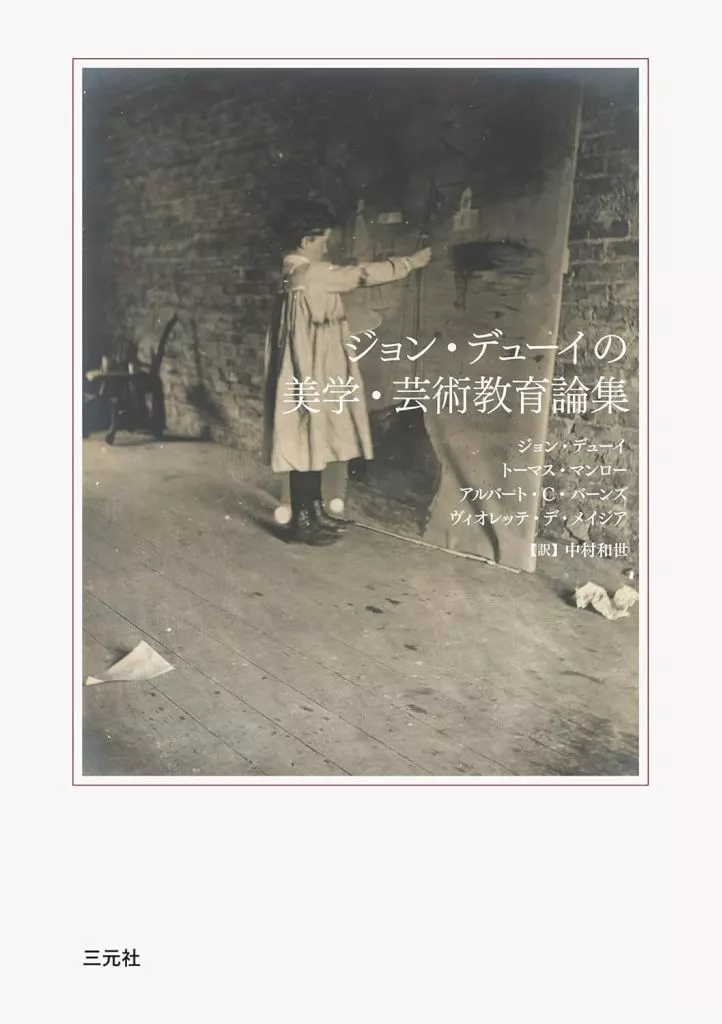
Education John Dewey's Essay on Aesthetics and Art Education / Thomas Munro / Albert C. Barnes


Product description ※Please note that product information is not in full comprehensive meaning because of the machine translation.
Education
[Introduction to Contents]
What can art education do to create an autonomous way of life rooted in democracy?
The solution is derived from the theory of education about 100 years ago.
Contents
Translator : Foreword
Legend
Part 1 : Principles and Methods of Art Education
Imagination and Expression (1896)
Aesthetic Elements in Education (1897)
Art in Education (1911)
Personality and Experience (1926)
Part 2 : Aesthetics and Art Psychology
Aesthetic sense (1887)
Emotional thinking (1926)
Philosophy of Art (1938)
Part 3 : Art Museum Education
Dedication at the Unveiling of the Barnes Foundation (1925)
Introduction to the Art 』 by Renoir 『 (1935)
Educational Functions of the Museum of Decorative Arts
Culture in Education
Culture and Industry in Education
Art as Our Heritage
Politics and Culture (1932)
Creative Democracy - Challenges Before Our Eyes (1939)
Part 5 : Art Education at the Barnes Foundation
Thomas Munro
Constructive Program for Art Education
Albert C. Barnes, ヴィオレッテ de Mejia
Method (1935)
Learn to See (1935)
Expression and Form (1935)
Experience and Growth (1935)
Translator Commentary
[Author profile]
John Dewey (John Dewey, 1859-1952)
American philosopher, psychologist, Vermont.
[Author profile]
John Dewey (1884 - 1894), President of the American Psychological Association, the American Philosophical Association, the National Kindergarten Association, the Honorary President of the Progressive Education Association, and the Lifetime Honorary President of the National Association of Education
From Burlington, Vermont.
After receiving a Ph.D. from Johns Hopkins University in 1884, he served as President of the American Psychological Association, the American Philosophical Association, the National Association of Kindergartens, the Honorary President of the Progressive Education Association, and the Lifetime Honorary President of the National Association of Education
John Dewey 1937 1940 1906 1923 1925 1894 1904 1905 1930 1919