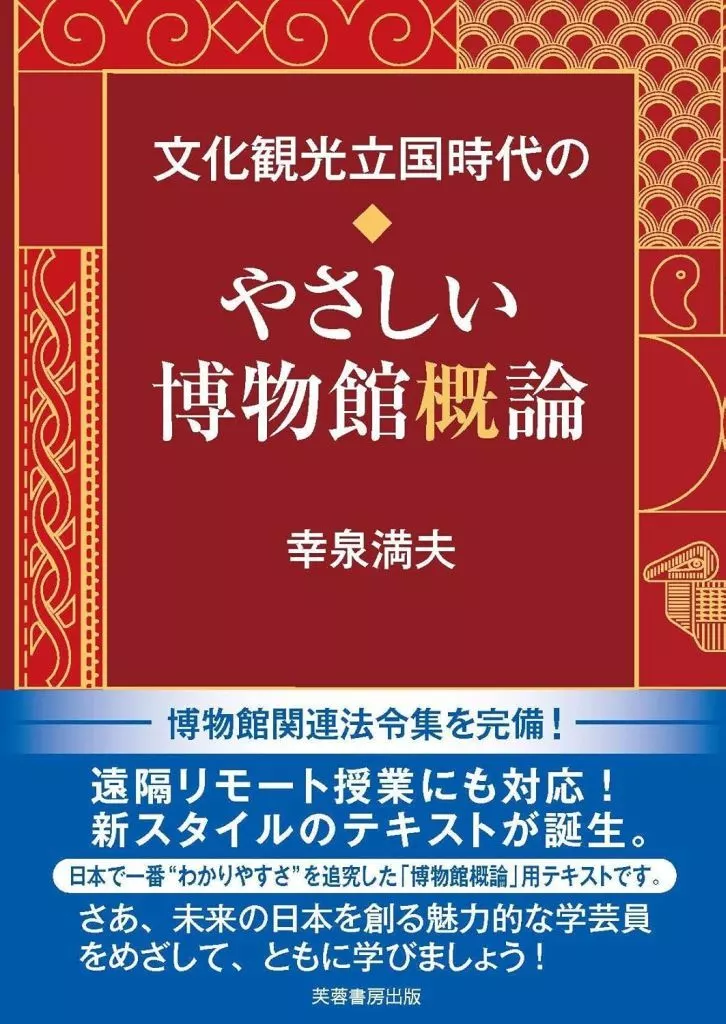
Social science Introduction to Museums in the Age of Culture and Tourism Nation / Mitsuo 幸泉


Product description ※Please note that product information is not in full comprehensive meaning because of the machine translation.
Social Science
[Content introduction]
New Three Perspectives (author's explanation)
1. Complete "Collection of Acts Concerning Museums"
Due to the major revision of the Museums Act in 2023, the 『 Museums Related Acts 』 (The Museum Association of Japan) of Japanese Museums), which had been used for many years, was discontinued.
It must be inconvenient for teachers who are in charge of museum science or curator qualifications.
The second half of Part II is complete with the latest "Related Laws and Regulations".
2. It is easy to handle remote classes.
The explanation is "Masumasu style" to increase the comprehension and absorption power of readers.
At the end of each chapter, there is also a "remote problem" which can be dealt with by remote asynchronous.
3. It is the curators who save the local disappearance.
It is the curators who can directly take charge of the promotion of culture, art, nature and tourism of each region that save the near future of the local region.
Part I : Introduction to Museums
Chapter I : Introduction to Museums
Section I-1 : Museum Facilities and Their Diversity
Section I-2 : What are curators?
Section I-3 : Museum Studies and Their Academic Systems
Section II-1 : Remote Issues (1) (2)
Section II : Major Duties Concerning Curators
Section II-2 : Collection Activities by Curators
Section II-3 : Collection Activities by Curators
Section II-3 : Collection of Materials by Curators
Section II-6 : Exhibition of Materials by Curators
Section II-6 : Dissemination and Educational Activities by Curators
Section III-1 : Spirit of the Constitution of Japan and Its Outline
Section III-2 : Outline of the Fundamental Law of Education
Section III-3 : Outline of the Fundamental Law of Culture and Arts
Section III-6 : Interpretation of the Museum Law
Section III-7 : Interpretation of the Ordinance for Enforcement of the Museum Law
Section III-8 : Outline of the Relevant Local Autonomy Law
Section III-9 : Interpretation of the Museum Law
Section III-10 : Interpretation of the Culture and Tourism Promotion Law
Section III-8 : Interpretation of the Museum Law
Section III-9 : Interpretation of the Ordinance for Enforcement of the Museum Law
Section IV-3 : History of Museums
Section IV-1 : Conditions of Museums
Section IV-2 : Prehistoric Sensitivities of Humans and their Potential Elements
Section IV-3 : Reimei of Museums around the Mediterranean Sea
Section IV-4 : History of Museums
Section IV-1 : Conditions of Museums
Section IV-2 : Prehistoric Influences of Humanity
Section IV-7 : Prehistoric Influences of Museums
Section IV-8 : History of Museums around the Mediterranean
Section IV-4 : History of Museums
Section IV-4 : History of Museums
Section IV-4 : History of Museums
Meiji
Section IV-12 : Tsuzoku Kyoiku to Gentaro Tanahashi
…
[Contents]
A new introductory textbook on "Museology" has been created that is complete with the latest collection of laws and regulations related to museums, and easy to handle even in remote classes!
Three new perspectives aimed at this book (author's explanation)
(1) Complete the "Collection of Laws and Regulations on Museums"
Due to the major revision of the Museums Act in 2023, the 『 Museums Related Laws and Regulations 』 (The Association of Japanese Museums), which had been used for many years, was finally abolished.
I'm sure it will be inconvenient for teachers from all over the country who are in charge of museum science and curator qualifications at universities.
Part II of this book is complete with the latest "Related Laws and Regulations".
(2) Easy to handle remote classes
During the recent pandemic, there was a great need for text that could be used in remote classes.
In this text, simple and concise explanations are provided in the "masumasu style" throughout each chapter so as to improve the reader's comprehension and absorption.
At the end of each chapter, there is also an abundance of "remote issues" that can be dealt with by remote asynchronous.
(3) It is the curators who save the rural disappearance
The talent who can utilize the curator qualification should be more various.
At a time when the population is decreasing and the disappearance of rural areas is becoming a reality, it is the curators who can directly take charge of promoting the culture, art, nature and tourism of each region that will save the near future of rural areas.
By making use of this book, there will be outstanding qualified curators who will be active in the community.
Part I : Introduction to Museums
Chapter I : Introduction to Museums
Section I-1 : Museum Facilities and Their Diversity
Section I-2 : What are curators?
Section I-3 : Museum Studies and Their Academic Systems
Section II-1 : Remote Issues (1)
Section II-3 : Remote Issues (2)
Section II-2 : Collection Activities by Curators
Section II-2 : Collection of Materials by Curators
Section II-3 : Preservation and Management of Materials by Curators
Section II-6 : Dissemination and Educational Activities by Curators
Section III-2 : Outline of the Fundamental Law of Education
Section III-3 : Outline of the Fundamental Law of Culture and Arts
Section III-6 : Outline of the Fundamental Law of Culture and Arts
Section III-5 : Outline of the Law for Promotion of Culture and Tourism
Section III-8 : Interpretation of the Museum Law
Section III-7 : Interpretation of the Ordinance for Enforcement of the Museum Law
Section III-10 : Interpretation of the Local Autonomy Law
Section III-8 : Interpretation of the Museum Law
Section III-9 : Interpretation of the Ordinance for Enforcement of the Museum Law
Section III-10 : Overview of Approved Facilities
Section IV-3 : History of Museums
Section IV-1 : Conditions of Museums
Section IV-2 : History of Museums
Section IV-4 : History of Museums around the Mediterranean
Section IV-4 : Origin of Museums in Japan
Section IV-6 : Signs of the Birth of Museums in Europe in the Middle Ages
Section IV-8 : History of Museums around the Mediterranean
Section IV-4 : Reimei of Museums around the Mediterranean
Section IV-7 : Signs of the Birth of Museums in Europe in the Middle Ages
Section IV-9 : History of Museums around the Mediterranean
Section IV-8 : History of Museums around the Mediterranean
Section IV-4 : Origin of Museums in Meiji
Section IV-12 : Secular Education and Gentaro Tanahashi
Section IV-13 : From the Birth of the Tokyo Science Museum to the Great Kanto Earthquake and World War II
Section IV-14 : Post-War Reconstruction and New Legislation
Section IV-15 : The Age of Curatorship
Section IV-17 : Recent Developments in Japanese Museums
Section IV-18 : Current Policies and New Issues
Section IV-18 : Current Policies and New Issues
Section IV-1 : Organizational Structure of Public Museums
Section V-2 : Volunteer System
Section V-3 : The Past and Future
Section V-4 : The Future Outlook
Section VI-1 : The Near Future
Section VI-2 : Three Advanced Cases Linking Regions and Museums
Section VI-2 : Three Advanced Cases Linking Regions and Museums
Section VI-1 : The Near Future
Section VI-1 : The Near Future
Section VI-2 : Three Advanced Cases Linking Regions and Museums
Section VI-2 : The Final Section of the Constitution of Japan
B Basic Act on Education
C Social Education Act
D Basic Act on Culture and Arts
E Culture and Tourism Promotion Act
F : Museum Act
G Ordinance for Enforcement of the Museum Act
I Act on the Protection of Cultural Properties
J Regulations on Publicly Approved Facilities
[Author's brief history]
Associate Professor of the Faculty of Law and Literature at Ehime University (in charge of Museum and Archaeology). [Major achievements] Jomon Pottery 』 in western 『 (co-written by Shinyosha, 2010), "New Possibilities of Museum Materials Science" 『 School of Law and Literature Collection 』, No. 37 (Ehime University, 2014), "History Education for Young Children at the London City Museum in the United Kingdom" 『 School of Law and Literature Collection 』 No. 41 (Ehime University, 2016), "Current Status and Prospect of Training Courses for Curators at Local National Universities" 『 Zenpaku Kyokai Kiyo 』 No. 19 (National University Museum Science Course Conference, 2017), "Emergence of Early Stage 『 Farming and Tsushima Warm Current Belt 』 (Academic book II on the results of Japan Society for the Promotion of Science Grant-in-Aid for Scientific Research, Seki Printing, published in 2023)," 『 Tsushima Warm Current "Prehistoric Pottery Culture 』 (published by Mt. Oyama Kaku, published in 2024), etc.