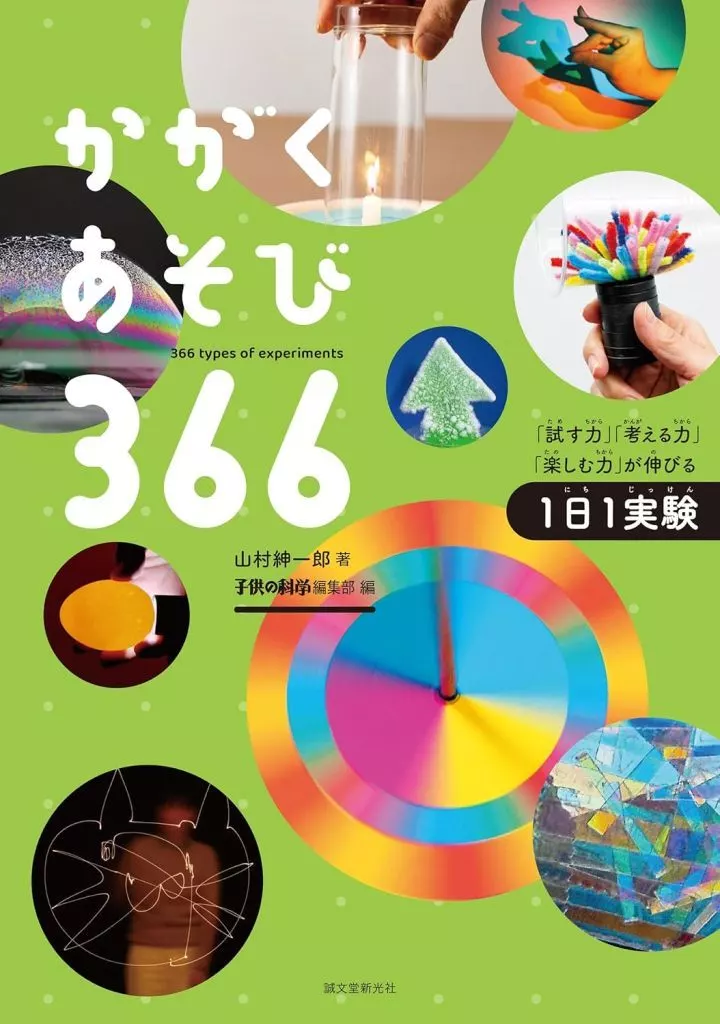
Book (Practical) Children's book KAKAKU ASOBI 366 / Shinichiro YAMAMURA / 『 Children's Science 』 Editorial Department


Product description ※Please note that product information is not in full comprehensive meaning because of the machine translation.
Children's Book "br" : A compilation of science magazines lasting 100 years! A 5 yen coin turned into a loupe? A cola turned into water? It is super easy super easy, it is amazing! Let's enjoy learning the science brain through science games one experiment per day. We collected 366 interesting science games that can be done using things in the house. When you bring a plastic bottle with water in front of your face, a strange face appears. When you turn a black and white top, it turns into a colorful top. A 100 yen coin placed on a bottle makes a lot of chatter. They are all strange things that make you want to ask "Why?" and "Why?". We encourage you to listen to these "Why?" and "Why?" while enjoying playing every day. We also recommend that you look at the "Why?" and "Why?" while enjoying playing every day. We also recommend that you check the commentary after you challenge science games. Although it is a little difficult for children, such as "lift", "refractive index" and "Bernoulli's Theorem", it can be used as a reference for science classes and independent research. Each experiment contains keywords related to the contents of the experiment. These words are still difficult for children, such as "lift", "refractive index" and "Bernoulli's Theorem", but they can be used as hints when you want to study in more detail and encourage your children to learn. Parents can research with children, and teachers can use them to find experiments that can be used in classes. Not only children who love science, but also children who are not good at science, and adults who have a strong literary background can naturally acquire the foundation necessary for science by "testing" what they feel strange, "thinking" about the results, and "enjoying" the whole process. In other words, they can naturally acquire the foundation necessary for science by "testing" what they feel strange, "thinking" about the results, and "enjoying" After challenging science games, you can also check the commentary. Although they are words that are still difficult for children, such as "lift", "refractive index" and "Bernoulli's Theorem", they can be used as hints when you want to 366