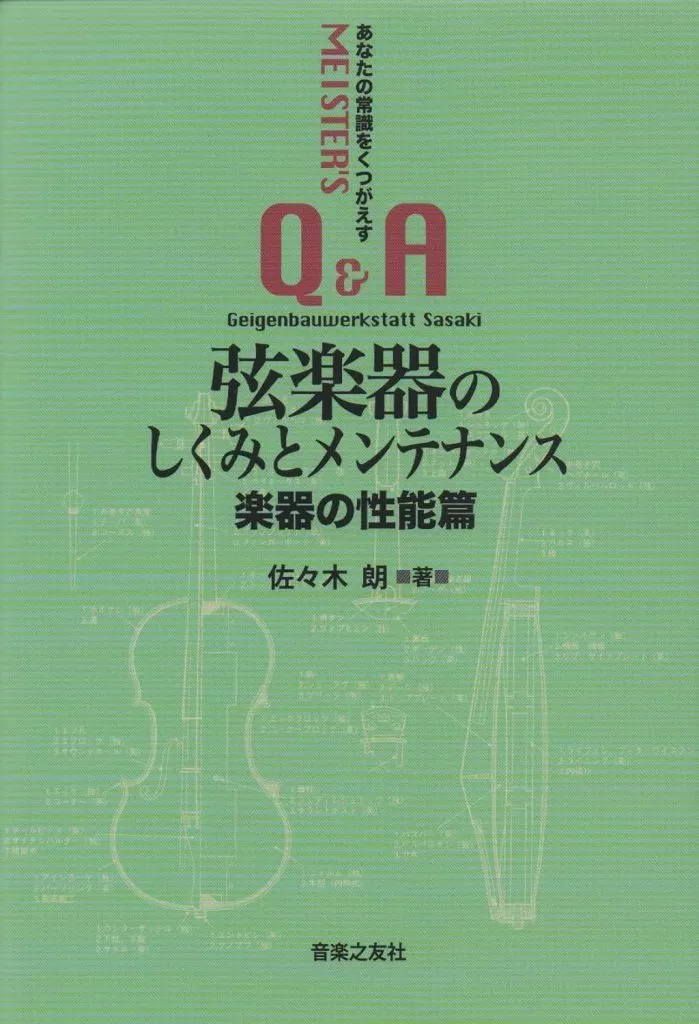
Book (Practical) Music Mechanism of String Instruments and Performance of Maintenance Instruments / Akira Sasaki


Product description ※Please note that product information is not in full comprehensive meaning because of the machine translation.
Music
[Contents introduction]
A violin-making meister asked a player of a string instrument (violin, viola, cello, contrabass) "How do you think about the performance of a string instrument?" "What kind of violins made of?" "The fingerboard of my viola is different from that of other people.
Why? " To 73 questions related to musical instruments, such as "Please tell me how to maintain the hair of the bow," I will answer them in a sincere and easy-to-understand manner while showing scientific evidence.
Full of tips to throw away the wrong "common sense" and step to the instrument in front of you!
The long-selling 『 string instrument since the first edition in 1999, the mechanism and maintenance 』, the title and cover design have been changed and reappeared.
Mechanism and maintenance of 『 stringed instruments The first part of 』.
[Table of Contents]
Chapter 1 Lies and Truths about String Instruments
What should we think of the performance of string instruments?
Why do violin family instruments have a longer life span than other instruments?
Why can't even modern science explain the violin?
Why is Stradivarius the only one so famous?
Is it really possible to appraise a musical instrument just by looking at it?
◎ Column I hear the word value of musical instruments. What does it mean?
What is the difference between a new instrument and an old one?
Are new musical instruments superior or inferior depending on the country where they were produced?
What is the difference between a mass-produced instrument and a handicraft instrument?
◎ Column Do you break down bad instruments and throw them away?
It is said that you can understand a musical instrument with good sound just by looking at it. Is it true?
I've heard that a good instrument is light. Is that true?
◎ Column fraction Is there any relation between the name of the instrument and the actual size?
Is it true that the first instrument that sounds a lot will stop playing soon?
Does the sound get better by playing?
◎ How big is the column viola?
■ Chapter 2 : Materials and Roles of String Instruments
What materials are violins made of?
Please tell me how to call each part of the instrument.
Is the spiral part related to sound?
What is the role of the back board of the instrument?
I heard that a single board is better for the back board. Is it true?
What is the striped pattern on the back board? Also, is it important for sound quality?
If you look inside the instrument, you can see a small board attached to the center line of the back board.
I was told that it is better to adjust the fingerboard, but what does it mean?
The color changed when I repaired the fingerboard.
Are there any negative effects?
My viola's fingerboard is different from others.
Why?
◎ What is "Hase" on the front panel of the column?
Please tell me the role of varnish.
There are alcohol varnish and oil varnish, but please tell me the difference and the good one.
Does the appearance of varnish differ depending on the surface finish of varnish?
◎ Column : What is the difference between "varnish" and "varnish"?
The varnish is easy to come off, what should I do?
■ Chapter 3 Knowledge of Bows. Various things
For the price of the bow, what fraction of the instrument is good?
What is the difference between an expensive bow and a cheap bow?
There are round bows and square bows, but what is the difference between them?
◎ Column How is the performance of the bow made of carbon fiber?
Is the broken bow repairable?
The tip of the bow chip is chipped. Can I use it as it is?
Please tell me how to maintain the hair of the bow.
About the difficulty of replacing the hair of the bow
There is a difference in the amount of hair replacement depending on the musical instrument shop. What kind of difference appears?
◎ You see the black haired bow of the column contrabass
How do you judge "when to replace hair"?
Please tell me about Matsutani.
◎ It seems that there are many kinds of windings for column bows. Which one would you like?
■ Chapter 4 Knowledge of Parts Surrounding a String Instrument
There are many kinds of strings, but what should I choose?
◎ Is it better to attach the tube attached to the string?
How much force is applied to the instrument depending on the strings?
There are various materials for spool and tail piece, but what is the difference between them?
I'm in trouble because the spool is loose.
Please tell me the correct position of the piece and how to stand it.
Please tell me more specifically how to fix the piece.
Does the sound become stronger when the piece is higher?
Please tell me about the adjuster.
I am using an adjuster embedded tailpiece. Should I exchange it?
I was surprised that the sound changed so much when I exchanged the shoulder clasp for a different one.
Please tell me how to choose the chin clasp.
Does the instrument stop working if I play with a silencer?
Is the "finger-plate falling prevention pad" effective?
What is a Wolf sound? Why is that? Can I lose it?
Where should I attach the cello Wolfkiller? Isn't there any bad influence?
Does the sound change depending on the end pin of the cello?
I often put a transparent film on the horizontal board of the instrument. Is it good for the instrument?
■ Chapter 5 Instrument Maintenance
How should I take care of the instrument after playing?
Is it better to loosen the strings after using the instrument?
Dust is accumulated inside the instrument. Is there any bad effect?
Please tell me about the heat countermeasure of the musical instrument.
Please tell me about the humidity countermeasure of the musical instrument.
◎ Should I put desiccant in the column case?
Please let me know the characteristics of the shape of the case and the difference of performance depending on the price.
If you ride a bicycle, please let me know the case which is safe for the musical instrument.
Falling of the cello case and breaking of the neck
◎ The screw which fixes the bow of the column case is loosened and it is a problem.
Author's brief history
Born in 1963 on Hachijojima Island, Tokyo.
Grew up in Hachijojima Island until high school.
In 1982, he entered the Department of Physics (Natural Science) at the University of Tsukuba.
At that time he joined the University of Tsukuba Orchestra and started a viola.
His enthusiasm for orchestra activities inspired him to take the job.
In 1987, he dropped out of university and entered the Tokyo Violin Production School of Zoroku Muryoto, a leading violinist in Japan.
After graduating in the jumping class and working as an assistant to Muryoto, he joined the studio of world-famous German producer Joseph Cantouscha as a ゲゼーレ (craftsman) in 1991.
In 1995, he returned to Japan after passing the Meister Examination for six months.
Opened Sasaki Violin Production Studio in Koenji, Suginami Ward, Tokyo Prefecture.
Currently, he is a German violin maker meister and a member of the Japan String Instrument Makers Association.
Sasaki Violin Production Studio Homepage : https://www.sasakivn.com/index.html
Sasaki Violin Production Studio Blog : https://sasakivn.com/blog/