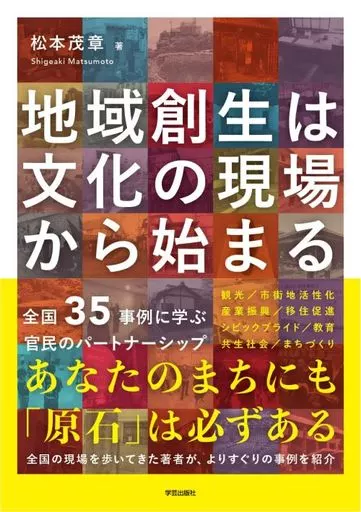
Society Shigeaki Matsumoto : Regional Revitalization Begins with Cultural Reality


Product description ※Please note that product information is not in full comprehensive meaning because of the machine translation.
Social
[Content introduction]
"Sites of culture" are not limited to traditional cultural facilities, but have expanded to all fields of the region such as tourism and industrial promotion, regional revitalization and town planning, and the situation surrounding cultural policies of local governments is changing drastically.
The author who has been walking around the country introduces 33 selected cases focusing on human resources and cooperation between the public and private sectors from the viewpoint of history, environment and food culture.
[Table of Contents]
Chapter 1 : "Expanded Cultural Sites and the Radically Changing Management of Local Communities"
1 : Cultural Sites Spread not only to "Traditional Cultural Facilities" but also to "Local Communities"
2 : The Basic Law for Culture and Arts, the Agency for Cultural Affairs, the Significance of Local Governance
3 : Changing Local Management - The Importance of Local Governance
5 : Local Communities Become Energized from Cultural Sites
Chapter 2 : "Industry, Food, Architecture, Scenery and Tourism" Creating Exchange with Local Resources "
1 : Walking Around Town with Local local industry
1 Mountain Village's Measures for Relocation of Artists by Making the Most of Nature - Nara Prefecture's" Takumi-no-Mura "
2 Promotion of Relocation by Clear and Spring Water - Wakasa Town, Fukui Prefecture's" Paradise Air "
4 Art Festival led by Migrant Artists - Tamba's" Tamba Sasayama Machinami Art Festival "
4 Art Festival led by Migrant Artists - Tamba's" Tamba Sasayama Machinami Art Festival "
4 Art Festival led by Migrant" Jack & Betty "
3 Actors' Appreciation Support Project for People with visual and hearing impairements
- Piccolo Vater, Amagasaki Youth Creative Theater
Chapter 9 [Cultural Hall and Entertainment Center × Town Development]
Form a new cultural facility to be opened in the community
1 Attempts to create a" commons "in municipal halls - The Prism Hall of the Osaka Municipal Cultural Hall
2 A home-like public cultural facility operated by a designated family manager
- Shinjuku Ward Frente Hall
4 A cultural facility with the participation of suburban residents - Nagae Kulttuuritalo
5 Reform of public cultural halls as a public relations strategy for cities
- Kobe Kobe Bunka Hall and 4300 1600 Irie Taikichi Memorial Museum of Photography Nara City Tanaka Museum of Art Lawn square Lawn square Kumamoto Castle Tojo-tei House HAPS Doshomachi Himeji City Ikaruga-cho Misato-cho Kusatsu City Aisho-cho Echigawa Kawakami-mura Saba-kaido Kumagawa Matsudo City Odawara City Sasayama City Higashiyama Ward Oyodo-cho Matsudo City Arahama Hikone City Toyonaka City Takizawa City Chikugo City Shea Kamaboko Street Yao City Nishinomiya City Nagakute City Kute Wakayamashi Wakayamashi Ariyoshi Sawa Ibaraichi Ibaraichi
Chairman of the Japan Art Management Society, Director of the Japanese Society for Cultural Policy, Representative of the Institute for Culture and Regional Design, and Specially Appointed Professor of Osaka University of Music.
Graduated from the Department of Education, Waseda University with a specialization in Geography and History, and completed the doctoral course (doctoral course) in the Graduate School of Policy Studies, Doshisha University.
Doctor of Policy Science.
After serving as a reporter, desk and bureau chief of the Yomiuri Shimbun, he served as a professor at Kochi Women's University (currently Kochi Kenritsudaigaku) (2006 〜 2011) and a professor at Shizuoka University of Culture and Arts (2011 〜 2022).
He visited cultural facilities in various parts of Japan and wrote a series in the Jiji News Agency's administrative magazine, 『 Local Administrative 』.
He wrote three books : 『 Art Creation Center and Trial 』 of Local Government Cultural Policy Kyoto Art Center (2006), 『 Cultural Policy 』 (2011) with public-private cooperation, and 『 』 (2015) walking through Japanese cultural facilities.
Edited and written by Designated Manager 』 (2019) who stands at the crossroads of 『, 』 (2020) who designs the area with 『 culture, 『 Art Management 』 (2021), 『 Heritage Management 』 (2022).
Co-authored : Introduction to 『, Cultural Policy, Independent Revitalization of 』 『 and Roles of Cultural Policy, 』 『, Culture and Art Governance of Municipal Government and Civic Cooperation 』, etc.