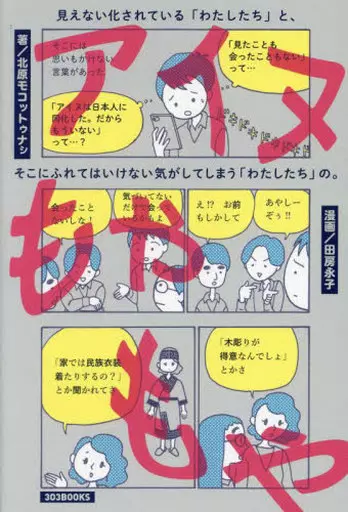
Ainu Moya Moya / Kitahara Mokoto Nashi / Eiko Tabusa


Product description ※Please note that product information is not in full comprehensive meaning because of the machine translation.
Society
[Introduction to the Contents]
[Participated in the editorial of Manga 『 GOLDEN KAMUY 』! Kitahara Mokkotonashi carefully explains the momoya around the Ainu]
The Ainu are a Japanese ethnic minority.
Even in dramas set in Hokkaidō, I rarely see the Ainu in Hokkaidō dramas. Textbooks only show the Ainu people wearing traditional costumes.
For non-Ainu people, the Ainu people living today seem to be on the other side of a thick "moya".
What do the Ainu people feel "moyamoya"?
Where does that "moyamoya" come from?
"Eiko Tabusa expresses" moyamoya "in comics about the structure of ignorance, incomprehension, and discrimination, as well as the relationship between the minority and the majority.
Eiko Tabusa has depicted from a sharp point of view and humor the conflict with excessive interference from his mother and the sense of alienation to the society centered on men.
In this book, Mr. Takafusa made comics about the various" moyamoya "that the Ainu people encounter in their daily life.
Mr. Kitahara's writing was very interesting and easy to understand. I also felt that I was stimulated by my lack of awareness about the majority, so I came to be able to grasp the structure of this society more clearly. In the comic book, I depicted So Ta, an Ainu boy who was born and raised in Tokyo, as the main character, and the people around him. I really want many people to read it.
Contents
Chapter 1 : It's hard to say.
Chapter 2 : Discrimination and Stereotypes
Chapter 3 : Identity My Way and Ainu Way
Chapter 4 : The Superiority of Majority
Special dialogue between Kitahara Mokko to Nashi and Eiko Tabusa
Chapter 2 : Discrimination and Stereotypes
Chapter 3 : Identity My Way and Ainu Way
Chapter 4 : The Superiority of Majority
Kitahara Mokko to Nashi 】※「 Shi was born in Suginami Ward, Tokyo in 1976.
Chronology of Past Events
Author's Biography
" Kitahara Mokko to Nashi Yamato Shi "was born Wana トーニンテマハ Eiko Tabusa Eiko Tabusa