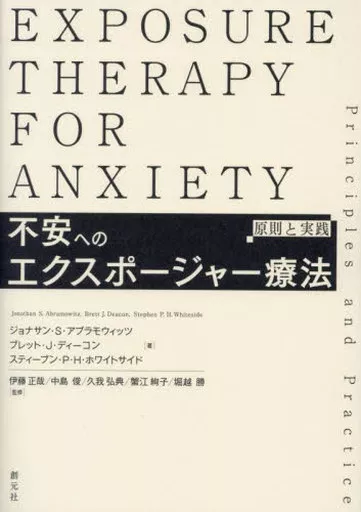
Psychology Anxiety Exposure Therapy / Jonathan S. Abramowitz / Brett J. Deacon


Product description ※Please note that product information is not in full comprehensive meaning because of the machine translation.
Psychology Therapeutic exposure (a technique that helps patients face fear) is an empirically supported, evidence-based technique for overcoming excessive fear and anxiety.
This book provides a comprehensive and practical guide to using exposure therapy for various problems associated with clinical anxiety, including the history and scientific knowledge behind exposure, how to assess various aspects of anxiety, and how to prepare for and implement exposure.
Contents
Introduction
Acknowledgments
Part I Foundations of Exposure Therapy
Chapter 1 Overview and History
Anxiety : Normal and Abnormal
Modern Exposure Therapy : Overview
History of Exposure Therapy
Conclusions
chapter 2 Effectiveness
Difficulty in Determining Effectiveness
Methods for Determining Effectiveness
Evidence of Exposure Therapy
Expert Consensus Guidelines
Conclusion
Chapter 3 Clinical Anxiety : Nature and Treatment
Why Clinical Anxiety Occurs
Why Anxiety Problems Persist
Cognitive Behavioral Models of Clinical Anxiety
Emotion Processing Theory and Inhibition Learning Theory
Conclusion
Chapter 4 Treatment Planning I : Functional Assessment
Problem List
Introduce Functional Assessment
Background and Medical History
Problem-related life history
Gather Information about Anxiety Experiences
Fear Clues : What Triggers Anxiety?
Feared Results
Safety Behaviors
Monitoring
Conclusions
Chapter 5 Treatment Planning II : Enhancing Preparedness and Creating Exposure Lists
Introducing Conceptual Models of Exposure Therapy
Creating Exposure Lists
principles of Exposure Therapy
Creating Exposure Lists
Situations Exposure (Real Exposures)
Imagined Exposures
Inner Sense Exposures
Reaction Prevention : Ending Safety Behaviors
Structure of Exposure Session
Preparing Exposure Issues
Reaction Prevention Homework
Reaction Prevention Homework
Various Ideas
Patients Become Their Own Therapists
Common Barriers
Examples
For people who want to learn more
Chapter 8 Exposure to Specific Fears
Fundamentals
Functional Assessment
Understanding Therapeutic Principles
Developing Practice Plans
Performing
Reaction Prevention
Hints and Pitfalls
Examples
Literature for people who want to learn more
Chapter 8 Environment (High, Confined, Open)
Basic
Functional Assessment
Reaction and Interference
Hints and Pitfalls
Case Studies
Literature for those who want to learn more
Chapter 13 Trauma
Clinical Features
Fundamentals
Functional Assessment
Understanding Treatment Principles
Making Practice Plans
Performing
Reaction and Interference
Hints and Pitfalls
Case Studies
Literature for those who want to learn more
Chapter 14 Blood, Injection, Injury
Clinical Features
Fundamentals
Functional Assessment
Understanding Treatment Principles
Making Practice Plans
Performing
Reaction and Interference
Hints and Pitfalls
Case Studies
Literature for those who want to learn more
Chapter 15 Imperfect, Asymmetric, or "Not Fitting" Feeling
Clinical Features
Fundamentals
Functional Assessment
Understanding Treatment Principles
Developing Practice Plans
Performing
Reaction and Interference
Hints and Pitfalls
Case Studies
Literature for those who want to learn more
Part III
Augmenting exposure therapy with medication : the future of combination therapy?
Clinical issues associated with combination therapy
Conclusions
Literature for those who wish to learn more
Chapter 20 Maintaining Recovery
When will it end?
Conclusion
Chapter 21 Leveraging Technology
Why Technology?
Technology Exposure Therapy
The Role of the Therapist
Conclusions
Chapter 22 Exposure Based on Acceptance & Commitment Therapy
What is ACT?
Exposure Therapy from the Perspective of ACT
Prepare
Introduce
Implement
Conclusions
Chapter 23 Risk-Benefit Analysis : For Non-Exposed Therapists
Beliefs about Exposure Therapy
Ideas to minimize risk
Maintain ethical boundaries
Conclusions
Translator : Postscript
References
Index
Biography
Professor of Psychology and Neuroscience, Professor of Psychiatric Research, and Director of the Clinic for Anxiety and Stress Disorders at the University of North Carolina at Chapel Hill. He is engaged in the study of anxiety and has published 250 papers, chapters and books. He is editor-in-chief of the Journal of Obsessive? Obsessive and Related Disorders and is an editor of other scientific journals. He has served as president of the American Society for Behavioral cognitive therapy and is a scientific and clinical advisory member of the International obsessive-compulsive disorder Foundation. He received a Research Merit Award from the Department of Psychiatry and Psychology of Mayo Clinic, and a Young Career Award from the Twelfth Division of the American Psychological Association for outstanding scientific contributions in clinical psychology.