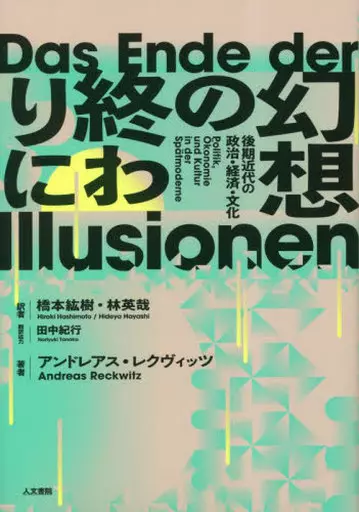
Society At the end of the illusion


Product description ※Please note that product information is not in full comprehensive meaning because of the machine translation.
SOCIETY
What does a society that pursues "uniqueness" bring us? A late modern era in which the "illusion" that society is advancing better has died. A new class society has emerged due to changes in industrial structure such as automation of production, digital revolution, and increase in simple service industries. A new liberal, ecological, and global-oriented middle class dominates, and individuals compete for "uniqueness". What does this change that is happening on a global scale bring to our lives? A new theory of society from Germany that vividly depicts the contradictions and ambiguities of modern society while covering the latest Western literature. / "Public discourse has shifted from firmly optimistic progressiveness to dystopia and nostalgia, i.e. from one selective perspective to another. That does not mean that it is easier than before to understand and cope with the structure of modern society. However, it is not necessary that the end of illusion leads to uniform pessimism. The absence of illusion can be a virtue that allows for calm realism and opens up space for analysis." (from this book) /◎ Contents / Introduction : Modern with Lost Illusions / Chapter 1 : Cultural Conflict as a Struggle for Culture - Hyperculture and Cultural Essentialism / Chapter 2 : From Levelled Middle Class Society to Three Class Society - New Middle Class, Old Middle Class, Unstable Class / Chapter 3 : Beyond Industrial Society - Polarized Post-Industrialism and Cognition, Cultural Capitalism / Chapter 4 : Exhausted Self-Realization - The Paradox of Late Modern Individuals and their Emotional Culture / Chapter 5 : The Crisis of Liberalism and Exploring New Political Paradigms - From Open Liberalism to Embedded Liberalism