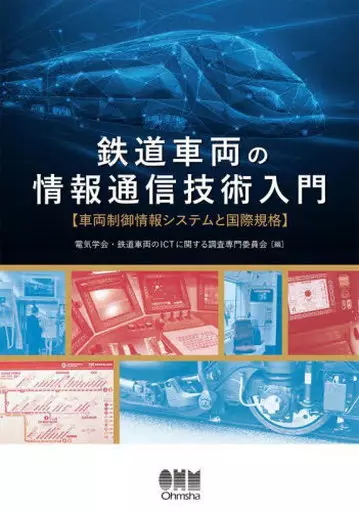
Book (Practical) Electrical engineering Introduction to Information and Communication Technology for Rolling Stock


Product description ※Please note that product information is not in full comprehensive meaning because of the machine translation.
Electrical Engineering
This is the first book in Japan that shows the information and communications technology used in railway vehicles! The importance of ICT is increasing in train trains as well, and ICT is being actively utilized. For railway vehicles, the introduction of in-vehicle microcomputer control equipment and the introduction of train information systems are advancing. Various devices on trains are connected to a network, and various information is being exchanged, supporting the enhancement of functions, reliability, and passenger services of trains. The Ethernet-based train control information system (TCN) is positioned as the center of this system construction. This book explains the basic technology, application examples, standards, and configuration technology of train control information systems. Chapter 1 summarizes the basic operation principle of train trains as a premise of this manual. Chapter 2 summarizes the principle and issues of the "lead-through wire system" which is the basis of the train control system. Chapter 3 summarizes the progress from the basic principle to the latest system of the "serial data transmission system" which is the core of the new control system corresponding to the high performance and high functionality of railway vehicles. Chapter 4 summarizes the specific application examples of information and communications technology using train transmission systems. Section 4.1 summarizes the vehicle control information system TCMS which controls the entire train and monitors equipment, which is the central function of railway vehicles. Section 4.2 summarizes the basic principles and issues of the "lead-through wire system" which is the core of the new control system for railway vehicles. Chapter 3 summarizes the progress from the basic principle to the latest system of the "serial data transmission system" which is the core of the new control system corresponding to the high performance and high functionality of railway vehicles. Section 4.3 describes the new maintenance system that handles video and audio data from the conventional periodic maintenance system to the CBM which performs advancement of information and communications technology of railway vehicles. Section 4.4 describes the new automatic operation system ATO using information and communications technology. Chapter 5 and 6 summarize the method of establishing international standardization of TCN, how it was established, how it was established, and the outline of the contents of the standard. Section 5 and 6 summarize the method of establishing international standardization of TCN, how it was established, how it was established, and the outline of the contents of the standard. Section 5 and 6 summarize the technical elements required for designing information and communications systems for railway vehicles from the conventional periodical maintenance system to real-time status monitoring, referring to TCMS which is a typical application example of TCN. Chapter 9 describes the linkage between on-board systems and ground systems which are newly developed in accordance with the advancement of information and communications technology. Chapter 5 and 6 summarize the method of establishing international standardization of TCN, how it was established, how it was established, and the outline of the contents of the standard. Section 5 and 6 summarize the technical elements required for designing information and communications systems for railway vehicles from the conventional periodic maintenance system