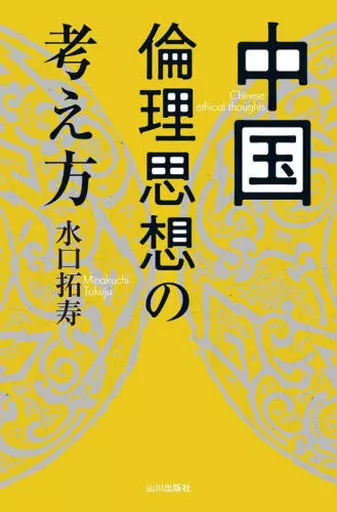
Oriental thought Concept of Chinese Ethical Thought


Product description ※Please note that product information is not in full comprehensive meaning because of the machine translation.
Oriental Thought The word "ethics" was born in the Chinese language and was introduced to the Japanese language. We have become accustomed to translating the English word "ethics" into "ethics," but as long as we rely on the image of ethics, "ethics" as a Chinese language does not reveal its true nature. Chinese ethical thought is represented by Ju-kyo. The ethical thought of Ju-kyo, which was created by Confucius and fostered by Moko and Junshi, became the "state religion" of successive dynasties and strongly regulated Chinese human relations and social order for more than 2000 years. What kind of ethics did they seek specifically? How did they think that the correct connection between people could be put into practice? And above all, can it be said that the ethical thought of Ju-kyo made everyone happy? In this book, we focus on the point where the ethical thought of Ju-kyo that began in the Spring and Autumn period was completed in the Former Han and the Later Han, and new developments by Chu His (Chu Shi) of the Southern Sung Dynasty and Wang Shuren (Wang Yangming) of the Ming Dynasty. We will talk in an easy-to-understand way about its theoretical path and its impact on society. We will not hesitate to touch on the part that was completed without logic and what should be called a negative legacy. I would like you to look at the ethical thought spoken in China from various angles and calmly.