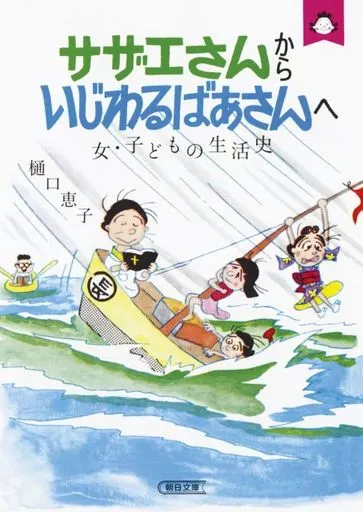
Library Comics, illustrations, and children's drawings From Sazae-san to Ijiwaru Grandma : Life Histories of Women and Children Asahi Bunko


Product description ※Please note that product information is not in full comprehensive meaning because of the machine translation.
Manga, Illustrations and Children's Paintings The author, who has been a fan of reading "Sazae-san" since the beginning of the newspaper series, visits the former residence of the author Machiko Hasegawa. He talks with his close friend in elementary school and his boss when he worked for the Nishinihon Shimbun newspaper, and tells how the life of Machiko Hasegawa has changed since World War II. At first glance, the author looks conservative like "the representative of the Showa family," but he explains that there is a feminist point of view in the Isono family. At a time when men like the so-called "Kyusyu Danshi" (Kyushu Boys) were the mainstream, he always paints a negative picture of such a bossy man. He takes his husband as an adopted son-in-law and as a "wife" instead of a "daughter-in-law," he freely socializes with neighbors, and sometimes works while maintaining his life. That is why the female writer was able to publish a daily life manga centered on housewives in a newspaper for 28 years. In addition, there are chapters such as Katsuo as a new male figure, Namihira who does not try hard, Fune who is an influential person, and "Okinage" of an old woman who does not do anything. It is easy to understand and read because it relates the events in "Sazae-san" with the postwar history. It is very easy to understand and read because it tells about the life of the Showa, as well as about Machiko Hasegawa. It also contains many cover illustrations and illustrations by Machiko Hasegawa. It also contains valuable illustrations that he drew when he was a painter of the Nishinihon Shimbun's Editorial Department.